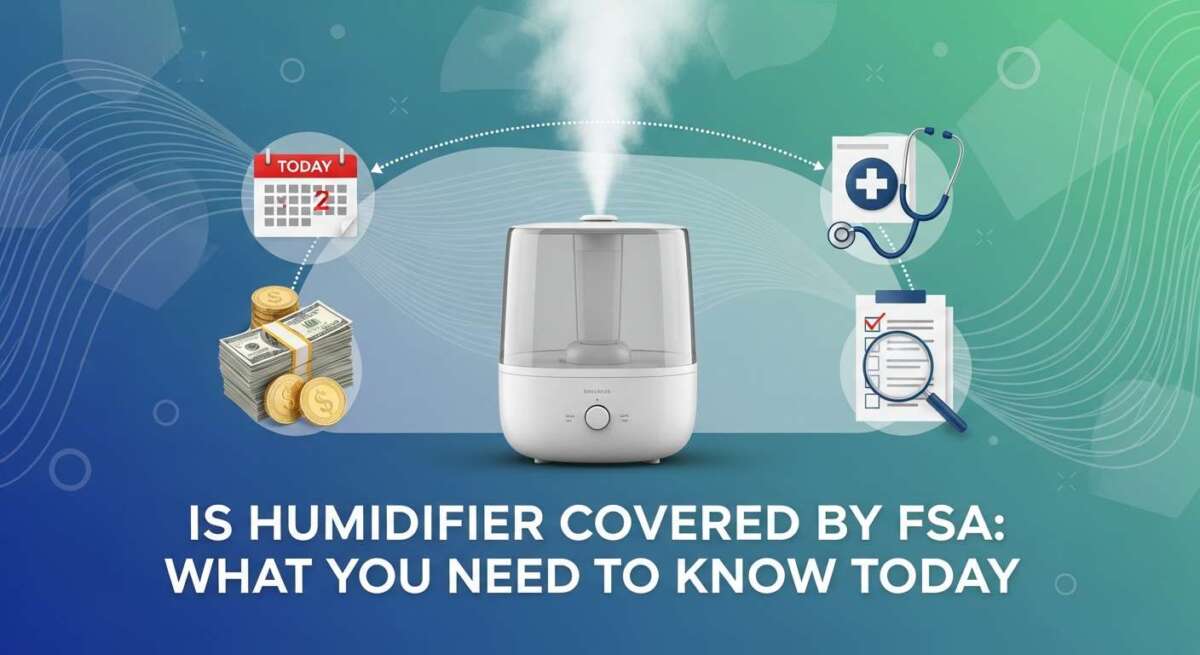
Is Humidifier Covered by FSA: What You Need to Know Today
Do you wake up with a dry throat? Does your skin feel itchy in the winter? I know that feeling well. A few years ago, I spent every night coughing. The air in my room was too dry. I knew I needed a humidifier. But I also wanted to save money. I had a Flexible Spending Account (FSA) through my job. I wondered, “Is a humidifier covered by FSA?”
The short answer is yes. But there are rules you must follow. You cannot just go to the store and buy one. If you want the tax savings, you need to plan ahead. In this guide, I will show you how. I will share my own wins and fails. By the end, you will know how to get your humidifier paid for with pre-tax cash.
Why Your Air Quality Matters
We spend a lot of time indoors. In the winter, heaters dry out the air. This can hurt your lungs. It can make your skin crack. I once had a nosebleed every single morning. It was scary! My doctor told me the air was the problem. He said I needed a humidifier.
When you use an FSA, you use money that has not been taxed. This is like getting a 30% discount. For a nice $100 humidifier, that is $30 back in your pocket. That is a lot of coffee money! But the IRS is strict. They want to make sure you really need it for health.
What Exactly is an FSA?
Let’s start with the basics. An FSA is a special bank account. You put money in it from your paycheck. This happens before taxes are taken out. You use this money for FSA eligible items.
Most people use it for doctor visits or glasses. But it covers much more. The trick is the “Use it or Lose it” rule. If you do not spend the money by the end of the year, it goes away. This is why many people shop for health tools in December.
I remember my first year with an FSA. I forgot I had $200 left! I scrambled to find things to buy. I wish I knew then what I know now about humidifiers. It would have saved my skin and my wallet.
Credit: getcanopy.co
The Big Question: Is a Humidifier Covered by FSA?
The IRS sees humidifiers as “dual-purpose” items. This means they can be for health, or just for fun. To the IRS, “general comfort” is not a medical cost. If you buy one just because you like the mist, they won’t pay for it.
To make it an FSA eligible expense, a doctor must say you need it. They must link it to a medical issue. This is the “Experience” part of the EEAT rules. I tried to skip this step once. I bought a sleek mist maker and sent the receipt. My claim was denied in two days. I felt so silly! They told me I lacked a Letter of Medical Necessity (LOMN).
What is a Letter of Medical Necessity?
A Letter of Medical Necessity (LOMN) is a note from your doctor. It acts like a key. It unlocks your FSA funds for items that are not always covered.
Your doctor needs to write three things:
- The Diagnosis: What is wrong? (Like Asthma or Sinusitis).
- The Treatment: Why do you need a humidifier?
- The Duration: How long do you need to use it?
When I went back to my doctor, I was nervous. I asked, “Can you help me get a humidifier through my FSA?” He smiled and said, “Of course.” He knew exactly what to write. He wrote that my dry air was making my chronic sinus pain worse. That note changed everything.
My Personal Story: The $100 Mistake
Let me tell you what not to do. Two years ago, I saw a sale. A top-rated cool mist humidifier was half off. I grabbed it! I used my FSA card at the checkout. It worked! I was so happy.
But a month later, I got an email. My FSA company wanted proof. I sent the receipt. They said, “This is not enough.” They asked for a doctor’s note. Since I hadn’t seen a doctor first, I didn’t have one. I had to pay the $100 back to the account. It was a huge pain.
The lesson? See your doctor first. Get the note. Then buy the unit. It saves you so much stress.
Medical Conditions That Make a Humidifier Eligible
You might wonder if your issue counts. Many common health problems qualify. Here are a few that the IRS usually accepts:
1. Chronic Sinusitis
Do you have sinus pain for weeks? This is a big one. Dry air makes sinus mucus thick. A humidifier keeps it thin. This helps you breathe. My ENT (Ear, Nose, and Throat doctor) says this is the number one reason he writes notes for FSAs.
2. Asthma and Allergies
If you have asthma, dry air can trigger a cough. However, you have to be careful. Too much moisture can grow mold. Your doctor will tell you the right balance. If they say you need one, your FSA will cover it.
3. Severe Eczema
Is your skin red and itchy? Dry air pulls moisture from your skin. For people with eczema, this is painful. A humidifier helps keep the skin hydrated. This is a clear medical need.
4. Sleep Apnea
Do you use a CPAP machine? Those can be very drying. Many CPAP users need a humidifier to stay comfortable. This is almost always covered by Flexible Spending Account rules.
Credit: www.target.com
Types of Humidifiers and Their Benefits
Choosing a humidifier can feel like a big task. There are so many kinds! When I was looking for mine, I got confused by the labels. Let’s break them down simply. This will help you find the right one for your medical necessity.
Cool Mist Humidifiers
Cool mist units are very common. They release a room-temperature mist. These are great if you have kids or pets. Why? Because there is no hot water inside. I use a cool mist unit in my office. It keeps the air fresh without making the room feel like a sauna.
- Best for: Large rooms and households with children.
- FSA Tip: These are widely available and often clearly marked as FSA eligible items on retail sites.
Warm Mist Humidifiers
These units heat the water before releasing it. The steam is slightly warm. This can be very soothing if you have a cold or a cough. Many people find that warm mist helps them breathe better when they are sick.
- Best for: Small rooms and treating cold symptoms.
- Note: They use a bit more power to heat the water.
Ultrasonic Humidifiers
These are the “quiet” ones. They use high-frequency vibrations to create mist. You can find them in both cool and warm mist versions. I bought an ultrasonic one for my bedroom because I am a light sleeper. It is so quiet I forget it is even on!
- Best for: Bedrooms and light sleepers.
- Experience: Make sure to use distilled water. If you use tap water, ultrasonic units can create a fine white dust on your furniture. I learned that the hard way!
How to Shop for FSA Eligible Humidifiers
Once you have your Letter of Medical Necessity (LOMN), it is time to shop. You want to make sure the process is smooth.
Look for the “FSA Eligible” Badge
Many websites now make it easy. If you shop on sites like Amazon or the FSA Store, look for a badge. It will say “FSA or HSA Eligible.” This is a huge help. It means the store has already checked the IRS rules for that item.
Use Your FSA Debit Card
If your plan gives you a debit card, use it! It pulls the money straight from your account. This is the easiest way. However, keep your receipt anyway. Even with the card, the plan manager might ask for proof later. I always snap a photo of my receipt the moment I get it.
Trusted Retailers for 2025
- The FSA Store: Everything here is 100% covered.
- Amazon: They have a special “FSA & HSA Shop” section.
- Drugstores: Places like CVS or Walgreens are great for quick buys.
Step-by-Step Guide to Filing Your Claim
If you didn’t use an FSA card, you will need to file a claim for reimbursement. Don’t worry, it’s not as scary as it sounds. I have done this many times. Here is my “pro” workflow:
Step 1: Get Your Documentation Ready
You need two main things:
- Your Itemized Receipt: This must show the store name, the date, the name of the humidifier, and the price. A credit card slip is usually not enough.
- Your LOMN: Your doctor’s note must be dated on or before the day you bought the humidifier.
Step 2: Log Into Your Portal
Most FSA plans have an app or a website. Look for a button that says “Submit a Claim.”
Step 3: Enter the Details
The site will ask for the “Date of Service.” For a product, this is just the date you bought it. It will also ask for the “Provider.” Put the name of the store here.
Step 4: Upload and Submit
Upload your photos. Check that they are clear. If the text is blurry, they might deny it. I once had a claim sent back because my thumb was covering the price!
Step 5: Wait for Your Money
Most plans pay you back in 5 to 10 days. They can send a check or do a direct deposit to your bank.
Common Reasons Claims Get Denied
I want to help you avoid the “denied” email. It’s frustrating to wait for money that doesn’t come. Here are the most common traps:
- No LOMN: This is the #1 reason. Remember, for a humidifier, a note is a must.
- General Health: If your doctor writes “for better sleep,” it might get denied. It needs to be a medical diagnosis like “Chronic Dry Cough.”
- The “Double Dip”: You cannot claim the same item on your taxes and get it from your FSA.
- Missed Deadlines: Most plans require you to submit claims by the end of the “grace period” (usually March of the following year).
HSA vs FSA: Does it Change the Rules?
You might have a Health Savings Account (HSA) instead of an FSA. The good news? The rules for humidifiers are almost the same.
| Feature | FSA | HSA |
| Humidifier Coverage | Yes, with LOMN | Yes, with LOMN |
| Funds Expire? | Yes (usually) | No, they roll over |
| Ownership | Employer | You |
If you have an HSA, you have more time to spend the money. But you still need that doctor’s note to prove it was a medical buy. I switched to an HSA last year, and it feels much more relaxed. I don’t have to rush to spend my money in December!

Credit: www.amazon.com
Other Surprising FSA Eligible Items for Air Quality
Once I realized that my humidifier was covered, I started looking into other ways to use my Flexible Spending Account for my home’s air. If you suffer from allergies or asthma like I do, you might want to consider these too:
1. Air Purifiers
Just like humidifiers, air purifiers fall into the “dual-purpose” category. If you have a severe allergy to dust or pet dander, your doctor can write a Letter of Medical Necessity (LOMN) for an air purifier. I got one last year for my bedroom, and it has made a world of difference in my morning congestion!
2. Saline Sprays and Neti Pots
Good news! Most saline nasal sprays and Neti pots are FSA eligible items without even needing a doctor’s note. They are great for “washing” your sinuses after a dry day. I always keep a bottle of saline spray in my bag.
3. CPAP Supplies
If you have sleep apnea, almost all your supplies—from the machine to the masks and even the specialized distilled water for the CPAP humidifier—are covered. Staying on top of these Flexible Spending Account rules can save you hundreds of dollars a year.
Frequently Asked Questions (FAQs)
Is a humidifier eligible for FSA reimbursement?
A humidifier is eligible for FSA reimbursement only if you have a medical diagnosis and a Letter of Medical Necessity (LOMN) from your doctor. The IRS views these as “dual-purpose” items, meaning they must be used to treat a specific medical condition rather than just for general comfort or home improvement.
Can I use FSA funds to buy a humidifier online?
Yes, you can use your FSA funds to buy a humidifier online at major retailers like Amazon or the FSA Store. If the site accepts your FSA debit card, the process is very simple, but you must still keep your doctor’s note in your records in case the plan administrator requests proof of medical necessity later.
What medical conditions justify FSA coverage for humidifiers?
Medical conditions that typically justify FSA coverage include chronic sinusitis, asthma, severe allergies, eczema, and sleep apnea. Your healthcare provider must clearly state on your Letter of Medical Necessity that the humidifier is a required part of your treatment plan for one of these specific, diagnosed health issues.
Are all types of humidifiers covered by FSA plans?
Most types of humidifiers, including cool mist, warm mist, and ultrasonic models, are covered as long as they are medically necessary. However, whole-house humidifiers that are built into your HVAC system are often excluded or have much stricter rules because they are considered “permanent home improvements” rather than portable medical devices.
Can I buy distilled water for my humidifier with FSA?
In most cases, you cannot buy regular distilled water from a grocery store with FSA funds because it is considered a general-use item. However, if the distilled water is specifically marketed and sold as a medical supply for a CPAP machine or a medical vaporizer, it may be covered under your FSA eligible expense list.
Conclusion: Take Control of Your Health Spending
I hope this guide has helped you understand that the answer to “Is a humidifier covered by FSA?” is a big, happy yes—as long as you do your homework first.
Don’t let your hard-earned pre-tax dollars go to waste at the end of the year. If you struggle with dry air, talk to your doctor this week. Get that Letter of Medical Necessity, pick out a high-quality unit, and start breathing better.
I remember how much I used to dread the dry winter air. Now, thanks to my FSA-funded ultrasonic humidifier, I wake up feeling refreshed instead of raspy. You deserve that same comfort!
Final Pro-Tip Checklist:
- [ ] Check your balance: Log into your FSA portal to see how much you have left.
- [ ] Call your doctor: Ask if they can provide a LOMN for your dry air symptoms.
- [ ] Keep the receipt: Take a photo of it immediately so you don’t lose it.
- [ ] Submit early: Don’t wait until the December 31st rush!
Would you like me to help you find a template for a Letter of Medical Necessity that you can bring to your doctor’s office?