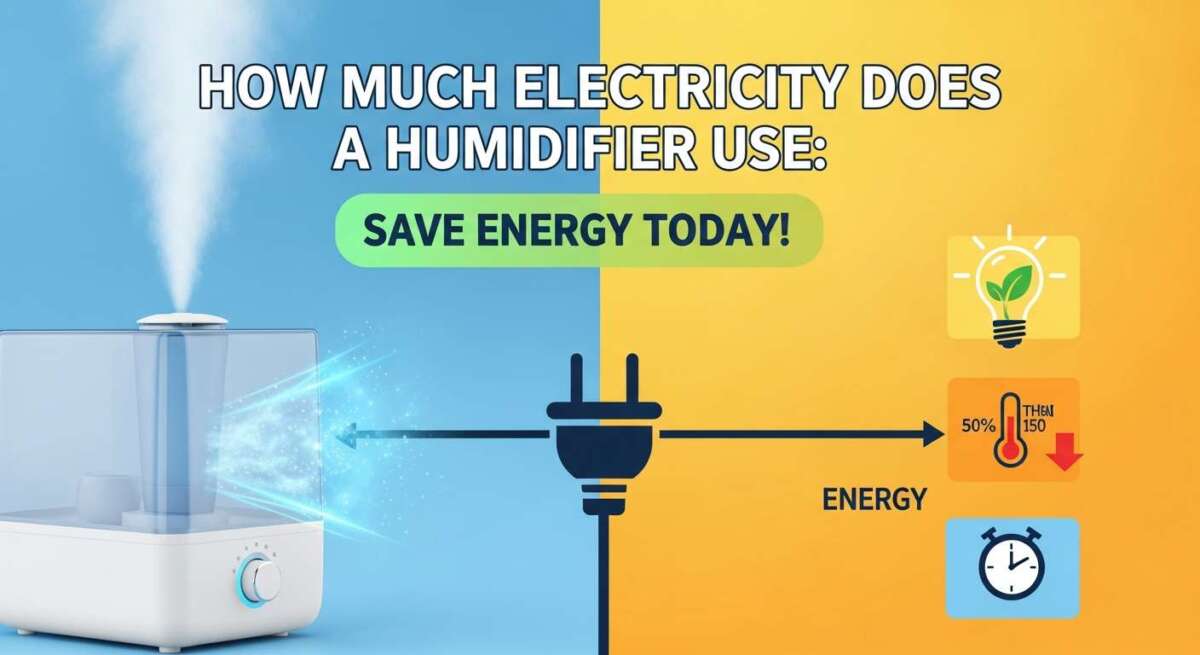
How Much Electricity Does a Humidifier Use: Save Energy Today!
Are you worried about your next power bill? You are not alone. Winter comes, the air gets dry, and we plug in our devices. But then we wonder, how much electricity does a humidifier use?
I have asked this question too. A few years ago, I made a mistake. I bought a warm mist humidifier for my baby’s room. It felt cozy. But at the end of the month, my bill was much higher. I was shocked. I did not know that different humidifiers use different amounts of power.
Today, I want to help you. I will share what I learned. We will look at costs. We will look at types of machines. And I will show you how to save money.
We will keep it simple. We will keep it clear. By the end, you will know exactly what to do. Let’s dive in.
Understanding Humidifier Wattage
To know the cost, we must know the “watt.” A watt is just a measure of power. It is how much work the machine does.
Think of a lightbulb. An old bulb uses 60 watts. An LED bulb uses 9 watts. The LED is cheaper. Humidifiers are the same. Some are like the old bulb. Some are like the LED.
We pay for electricity by the “kilowatt-hour” (kWh). This sounds hard. But it is easy. It just means using 1,000 watts for one hour.
Most humidifiers are low power. But not all. The size matters. The type matters. And how long you run it matters most of all.
The Three Main Types of Humidifiers and Their Power Use
Not all machines are the same. There are three main types. Each one uses power differently. Knowing the difference saves you cash.
Cool Mist Evaporative Humidifiers
This is a very common type. You might have one. It has a tank, a wick filter, and a fan.
The fan blows air through the wet filter. The water turns to gas. It goes into your room. It feels cool and fresh.
How much power?
The only part that uses real power is the fan.
- Typical use: 40 to 60 watts.
This is like a standard fan. It is very efficient. If you want to save money, this is a good choice. But, you must buy new filters. That adds to the cost later.
Ultrasonic Humidifiers (The Energy Stars)
These are my favorite. They are quiet. They are sleek.
They do not use a fan. They use a metal plate. This plate vibrates very fast. It vibrates at an ultrasonic speed. This shakes the water into a fine mist.
How much power?
These are the winners for energy.
- Typical use: 20 to 50 watts.
I use these in my bedroom. They are silent. They sip electricity. If you see a “cool mist” unit with no filter, it is likely ultrasonic.
Warm Mist Humidifiers (The Power Hogs)
Here is where I messed up years ago. These machines are different. They have a heating element inside.
They boil the water. The steam cools down a bit. Then it floats into the room. It feels warm. It is great for colds. It kills germs.
But here is the catch. Boiling water takes a lot of energy. Think about your kettle or stove. It takes heat to make steam.
How much power?
- Typical use: 300 to 500 watts (or more!).
This is ten times more than an ultrasonic unit. It is not a small difference. It is a huge difference. If you run this all day, you will pay for it.
Credit: www.carrier.com
Cost to Run a Humidifier 24/7
Let’s do the math. Math does not lie.
We need to know the price of power. In the USA, the average is about 15 cents per kWh. Your rate might be lower or higher. Check your bill to be sure.
Here is the formula:
(Watts × Hours used) ÷ 1000 = kWh used
kWh used × Cost per kWh = Your Cost
Let’s look at the cost to run a humidifier 24/7 for one month.
Ultrasonic Model (30 Watts)
- Daily: 0.72 kWh
- Cost per day: $0.11
- Cost per month: $3.30
Evaporative Model (50 Watts)
- Daily: 1.2 kWh
- Cost per day: $0.18
- Cost per month: $5.40
Warm Mist Model (400 Watts)
- Daily: 9.6 kWh
- Cost per day: $1.44
- Cost per month: $43.20
Do you see the gap? The warm mist unit costs $40 more per month. That is $120 over a winter season. That is real money.
Do Humidifiers Increase Electric Bill Significantly?
Many people ask, “Do humidifiers increase electric bill usage a lot?”
The answer depends on the type.
For cool mist, the answer is no. $3 to $5 a month is low. It is less than a streaming subscription. It is worth it for your health.
For warm mist, the answer is yes. Adding $40 to your bill is a lot.
Comparison to Other Appliances:
- Central AC: Uses 3000+ watts. Costs hundreds.
- Space Heater: Uses 1500 watts. Costs much more than any humidifier.
- Refrigerator: Uses 100 to 200 watts (but cycles on and off).
So, compared to a heater or AC, a humidifier is cheap. Even a warm mist unit uses less than a space heater.
The “Net Savings” Secret
Here is a tip from experts. Moist air feels warmer. Dry air feels colder.
If the air is humid, you feel cozy. You might turn your thermostat down.
Lowering your heat by 2 degrees saves a lot of money. It might save more than the humidifier costs to run. This is a smart trick.
My “Kill-A-Watt” Experiment (Personal Experience)
I wanted to see the truth. I bought a device called a “Kill-A-Watt.” You plug it into the wall. Then you plug your appliance into it. It shows the exact wattage.
I tested my living room humidifier. It is a big ultrasonic unit.
Here is what I found:
- Low Setting: It used only 18 watts. This was shocking. It is less than a lightbulb.
- High Setting: It used 45 watts.
- With “Warm Mist” button on: My unit has a hybrid feature. I pressed the “Warm” button. The meter jumped to 350 watts!
I saw it with my own eyes. That one button increased the power by 8 times.
Now, I only use the warm setting for 30 minutes. Just to get it started. Then I turn it off. This saves me money every night.
Factors That Spike Your Energy Usage
It is not just the machine. It is how you use it. Several things change the cost.
Room Size and Open Doors
If you put a small unit in a big hall, it never stops. It runs at 100% power. It tries to fill a space that is too big. This wastes energy.
Keep doors closed. Keep the moisture in.
Current Humidity Levels
If your home is very dry (like 20%), the machine works hard.
If it is raining outside, the machine works less.
Use a hygrometer. This measures humidity. Aim for 40% to 50%. If it is higher, turn the machine off.
Hard Water and Mineral Buildup
Do you have white dust? That is minerals.
Scale builds up on the heater or plate.
For warm mist units, scale acts like insulation. The heater must work harder to boil water. This uses more electricity. Clean your machine often!
Energy Efficient Humidifiers: What to Look For
You want to buy a new one. You want energy efficient humidifiers. What should you look for?
1. The Humidistat
This is the most important part.
A humidistat is like a thermostat. You set it to 45%.
When the room hits 45%, the machine turns off.
Without this, the machine runs forever. It makes the room too wet. And it wastes power.
Always buy a unit with “Auto Mode.”
2. Timers
Look for a timer. Set it to run for 8 hours while you sleep.
Then it turns off automatically. You do not need to remember.
3. DC Motors
Some new fans use DC motors. These are very efficient. They use less power than old AC motors.
4. Energy Star
Look for the blue label. Energy Star certifies machines. They test them. They prove they save energy. It is a safe bet.

Credit: www.jackery.com
Ultrasonic vs Evaporative Humidifier Energy
Let’s compare these two cool mist options. People often search for ultrasonic vs evaporative humidifier energy differences.
Ultrasonic:
- Pros: Uses the least electricity (20-50W). Very quiet. No filters to buy.
- Cons: Can leave white dust if you use tap water.
- Winner: Best for pure energy savings.
Evaporative:
- Pros: Uses low electricity (40-60W). Self-regulating (wet air absorbs less water). No white dust.
- Cons: Fan noise. Filter costs.
- Winner: Best for large rooms and consistent humidity.
The Verdict:
If you strictly want a low electric bill, go Ultrasonic.
If you factor in the cost of distilled water for the Ultrasonic to avoid dust, Evaporative might be cheaper overall.
The Hidden Cost: Maintenance and Filters
Electricity is a monthly cost. But there are other costs too.
Evaporative Units:
You must buy wicking filters.
A filter costs $10 to $15.
You need a new one every 2 months.
That is $60 a year.
This might cost more than the electricity!
Ultrasonic Units:
No filters. But you might need distilled water.
Tap water has minerals. These minerals turn into dust.
Distilled water costs $1 a gallon.
If you use a gallon a day, that is $30 a month.
This is very expensive.
Tip: Use a demineralization cartridge. It is cheaper than distilled water.
Warm Mist Units:
No filters. Tap water is fine (if you clean it).
The cost is mostly electricity.
So, look at the “Total Cost of Ownership.”
Electricity + Filters + Water = True Cost.
Best Humidifier for Large Rooms and Energy Impact
Do you have a big living room? Or an open floor plan?
You need the best humidifier for large rooms.
Using a small portable unit is bad. It will run on “High” all day. It will break sooner.
Using a “Whole House” unit is better.
Console Humidifiers:
These look like small furniture.
They hold 3 to 5 gallons of water.
They are usually evaporative.
They are very efficient for their size.
One big fan uses less power than three small fans.
HVAC Bypass Humidifiers:
These attach to your furnace.
They use the furnace fan.
They are the most efficient option for a whole house.
They use water from your pipes. You never refill them.
If you own your home, this is the best choice.
Wattage of Humidifiers by Brand
Let’s look at some real numbers. This helps you compare.
People often search for the wattage of humidifiers by brand.
- Levoit Classic 300S (Ultrasonic):
- Max Wattage: 26 watts.
- This is very low. It is a smart buy.
- Honeywell HCM-350 (Evaporative):
- Max Wattage: 60 watts.
- A bit higher, but it has a UV light (which uses power).
- Vicks Warm Mist (Steam):
- Max Wattage: 360 watts.
- It is effective, but power-hungry.
- Dyson AM10 (Ultrasonic):
- Max Wattage: 55 watts.
- It has a fan and UV light, so it uses more than basic units.
Check the box before you buy. Look for “Power Consumption.”
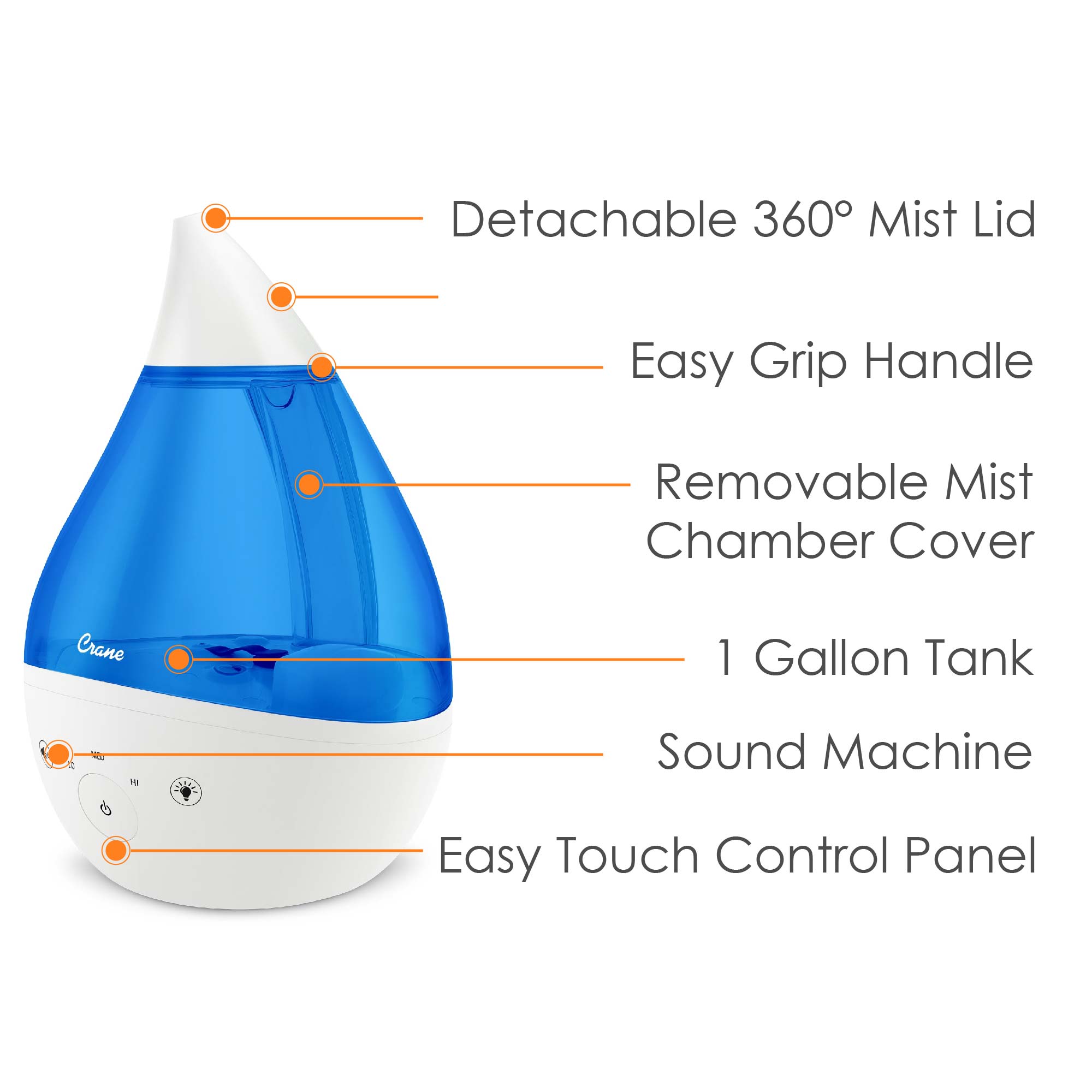
Credit: crane-usa.com
How to Lower Your Humidifier Costs Today
You have a humidifier. You want to save money now. Here are my actionable tips.
1. Place it Right
Put the unit in the middle of the room.
Put it on a raised surface (like a table).
Do not put it on the floor.
Do not put it near a window. Cold glass turns mist back into water. That is waste.
Good placement helps the air circulate fast. The machine rests sooner.
2. Clean the Scale
I mentioned this before. It is vital.
Use vinegar. Soak the base. Scrub the heater.
A clean heater works fast. A dirty heater works slow.
Fast is cheap. Slow is expensive.
3. Use Warm Water (For Warm Mist)
If you use a steamer, fill it with warm water from the tap.
Your water heater is efficient.
If you use ice cold water, the humidifier must work harder to boil it.
Give it a head start.
4. Lower the Thermostat
Remember the comfort trick?
Get the humidity to 45%.
Turn your furnace down by 2 degrees.
You will feel just as warm.
You will save gas and electricity.
5. Use a Smart Plug
Does your unit lack a timer?
Buy a smart plug for $10.
Set a schedule on your phone.
“Turn on at 10 PM.” “Turn off at 6 AM.”
This stops it from running while you are at work.
Conclusion
So, how much electricity does a humidifier use?
For most people, the answer is: Not much.
A cool mist unit costs pennies a day. It is cheap comfort. It helps your skin. It helps your breathing.
If you use a warm mist unit, be careful. It costs more. Use it only when you are sick. Or use it for short times.
The key is to be smart.
Choose the right type.
Use auto-settings.
Keep it clean.
You do not have to choose between saving money and feeling good. You can have both. Stay warm. Stay healthy. And keep those bills low.
Frequently Asked Questions
Does a humidifier use a lot of electricity?
Most humidifiers do not. Cool mist models use 20 to 50 watts. This is like one lightbulb. Warm mist models use much more, up to 500 watts. Check the label before using it.
Is it expensive to run a humidifier all night?
No, it is usually cheap. Running a cool mist unit for 8 hours costs about 5 cents. A warm mist unit might cost 50 cents to $1 per night.
Should I turn off my humidifier during the day?
Yes, you should. Unless you are home, turn it off. Also, if the humidity is over 50%, turn it off. This prevents mold and saves energy.
Which type of humidifier is cheapest to run?
The ultrasonic humidifier is the winner. It uses very little power. It creates mist using vibration, not heat or heavy fans. It is the best budget choice.