Can You Wear Headphones While Driving: Safety Insights
Imagine this. You are driving down the highway. The sun is shining. The road is open. You want to listen to your favorite song. But your car radio is broken. Or maybe the speakers just sound bad.
So, you reach into your bag. You pull out your shiny, new noise-cancelling headphones. You put them on. The world goes quiet. The music starts. It feels great.
But then, you see flashing lights in your mirror. You did not hear the siren. You did not hear the honk. Panic sets in.
This happened to me.
Years ago, my car radio died. I had a four-hour drive ahead. I thought, “I will just wear my earbuds.” It seemed like a good idea. It was not. I almost merged into a fire truck. I did not hear it coming. The silence in my car was dangerous.
That day, I asked myself: Can you wear headphones while driving?
I spent weeks looking for the answer. I looked at laws. I looked at safety data. I talked to experts.
Now, I want to share what I found. We will talk about safety. We will talk about laws. We will talk about how to protect yourself and your wallet.
Let’s dive in.
The Big Question: Is It Illegal to Wear Headphones While Driving?
The short answer is: It depends.
Driving laws are not the same everywhere. In some places, you can do it. In others, you will get a ticket fast.
This can be confusing. You might drive from one state to another. What is legal in one town might be illegal in the next.
But why is there confusion?
Most laws were written before modern headphones existed. They were written before Airpods. They were written before Noise Cancellation.
However, the core rule of the road is always the same. You must be alert. You must be able to hear.
Even if there is no specific law, a police officer can still stop you. They can say you are distracted. This falls under distracted driving fines. And trust me, those fines are not cheap.
So, while you ask, “Can I?” you should also ask, “Should I?”
Credit: www.autoguide.com
Driving With Headphones Laws by State: A Deep Dive
Let’s get specific. Where can you wear them? Where are they banned?
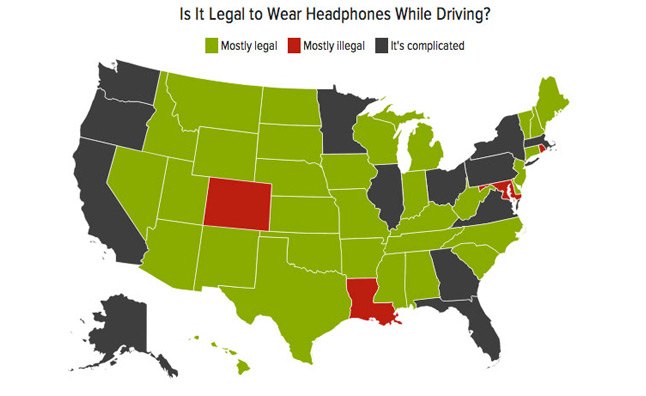
I have looked at the vehicle codes for many states. Here is a breakdown. This will help you understand driving with headphones laws by state.
The “Strict No” States
In these states, covering both ears is illegal. If a cop sees headphones on your head, you will get pulled over.
- Alaska: You cannot wear headgear that blocks hearing.
- California: This is a big one. You cannot cover both ears. You can only put a bud in one ear.
- Florida: It is illegal to wear a headset.
- Louisiana: No headphones allowed.
- Maryland: Both ears covered? That is a ticket.
- Minnesota: No headphones allowed.
- Ohio: Illegal for both ears.
- Rhode Island: Illegal.
- Virginia: Illegal.
- Washington: Illegal.
The “One-Ear” Exception
Some states are a bit more flexible. They know people use headsets for phone calls. So, they allow you to use one earbud.
- California: One ear is okay.
- New York: You can use one ear. But if you cover both, you break the law.
- Illinois: Single-ear headsets are allowed.
The “Legal But Risky” States
Some states do not have a specific law about headphones. This includes places like Texas or Nevada.
But be careful.
Just because there is no specific law does not mean you are safe. Every state has a “Distracted Driving” law. If you crash while wearing headphones, you are in trouble. The officer will write in the report that you were distracted. This can lead to distracted driving fines and higher insurance rates.
My Advice:
Always act like it is illegal. It is safer that way. Check your local DMV website to be 100% sure. Laws change often.
The Science of Sound: Safety of Wearing Headphones While Driving
Why is it dangerous? It is just music, right?
Not exactly.
Driving is mostly visual. You look with your eyes. But your ears are your second line of defense.
Your ears hear things your eyes cannot see.
- You hear a car in your blind spot.
- You hear a siren blocks away.
- You hear screeching tires.
- You hear your own engine making a weird noise.
When you block your ears, you lose this data.
The “Inattentional Blindness” Effect
This is a fancy term. But it is simple to understand.
When your brain loves a song, it focuses on the song. It stops paying attention to the road. You might “see” a red light, but your brain is singing along. You might react too late.
There is also the issue of isolation. This impacts the safety of wearing headphones while driving.
Modern headphones are too good. They block everything. If you wear them, you are in a bubble. A bubble is bad when you are moving at 60 miles per hour.

Credit: www.cnet.com
Headphones vs. Car Speakers Safety: A Real Comparison
You might think, “My car stereo is loud. What is the difference?”
This is a great question. I used to think this too. But there is a huge difference.
Let’s look at headphones vs car speakers safety.
The Air Gap
When you use car speakers, there is air between the speaker and your ear. Sound from the outside—like a horn—can mix with the music. You can still hear the horn.
The Seal
Headphones create a seal. They plug your ear canal. Or they cup over your ear. This physically blocks sound waves from the road.
My Parking Lot Experiment
I wanted to test this. I went to an empty parking lot. My friend stood 50 feet away.
- Test 1: I played music on car speakers. My friend yelled “Stop!” I heard him.
- Test 2: I put on my noise-cancelling headphones. I played music. He yelled “Stop!” I heard nothing. I kept driving.
That scared me. Even at low speeds, I was deaf to the world.
Car speakers allow “ambient noise” in. Headphones keep it out. That is the key difference.
Types of Headphones and Their Risks
Not all headphones are the same. Some are riskier than others.
Over-Ear Noise Cancelling (ANC)
These are the most dangerous for driving.
They use microphones to listen to outside noise. Then, they create a wave to cancel it out. They are designed to make the world disappear.
Do not wear these while driving. You will not hear emergency vehicles.
In-Ear Buds (IEMs)
These fit inside your ear canal. They act like earplugs. Even if the music is off, they block sound. They reduce your awareness.
Open-Back Headphones
These have holes in the cups. They let sound in. They are safer than ANC headphones. But they still distract you.
Bone Conduction Headphones
These sit on your cheekbones. They do not go in your ear. Your ear canal stays open.
This is the safest type. You can hear the road and your music. However, the music can still distract your brain.
Transparency Mode
Many new buds have “Transparency Mode.” This uses mics to pump outside sound into your ear.
Is it safe? Maybe.
Is it legal? In strict states, no. The law usually bans “covering” the ear. Even if the tech lets sound in, the device is physically on your ear. You might still get a ticket.

Credit: www.geekwire.com
Exceptions for Hearing Aids Driving: What You Need to Know
There is one big exception to these rules.
If you are hard of hearing, you need help. You need exceptions for hearing aids driving.
Most laws allow hearing aids.
Why?
Because hearing aids are designed to add sound, not block it. They help you hear the road better. They make you a safer driver.
Headphones are for entertainment. Hearing aids are for medical necessity.
However, be careful with “hearing assist” apps on your phone paired with normal earbuds. A police officer might not know the difference. If you use a medical device, keep your paperwork handy.
Also, some hearing aids connect to Bluetooth. You can stream music to them. If you do this, keep the volume low. You still need to hear the sirens.
The Hidden Cost: Distracted Driving Fines and Insurance
Let’s talk about money. Breaking the law costs you.
If you get caught, you face distracted driving fines.
The Ticket Cost
- In California, a first offense might be around $160 after fees.
- In New York, it can be $150.
- Some states add points to your license. Too many points, and you lose your license.
The Insurance Trap
This is the part nobody talks about.
Imagine you get in a crash. It was not your fault. The other guy ran a red light.
But, the police report says you were wearing headphones.
The insurance company sees this. They say, “You were distracted. You contributed to the accident.”
They might deny your claim. You could be stuck paying thousands of dollars.
Or, your monthly rate goes up.
Is it worth it for a few songs? No.
My Personal Experience: The Day I Learned My Lesson
I want to tell you more about my story. It changed how I drive.
I was driving from Ohio to Chicago. It is a long, boring drive. Cornfields everywhere.
My old sedan had a broken radio. It just hissed.
I put in my earbuds. I put on a podcast. I was happy.
I was in the left lane. I was passing a truck.
Suddenly, I saw blue lights in my rearview mirror. They were right on my bumper.
I had no idea how long they had been there.
The trooper was angry. I pulled over.
He walked up to my window. I pulled my earbuds out.
He said, “Son, I have been behind you for two miles with my siren on.”
My face went red. I felt terrible.
I was not speeding. I was not texting. But I was blocking the world out.
He gave me a warning. But he told me something important.
“If I was an ambulance, and you didn’t move, someone could have died.”
That stuck with me. Since that day, I never wear two earbuds. If I must, I wear one in my right ear (away from the window). But usually, I just sing to myself if the radio is broken.
Alternatives to Wearing Headphones
So, your radio is broken. Or you want to listen to a private call. What can you do?
You have options. These are safer. These are legal.
1. Bluetooth Speakers
Buy a portable Bluetooth speaker. They are cheap. They sound good.
Put it in your cup holder. Or velcro it to your dash.
It acts like a car radio. It fills the car with sound. But it leaves your ears open.
This is the best fix for a broken car stereo.
2. FM Transmitters
Does your car have a cigarette lighter? Does it have an FM radio?
Buy an FM transmitter. It plugs into the power outlet. You connect your phone to it via Bluetooth. It broadcasts your music to an empty FM station on your radio.
It costs about $20. It works great.
3. Smart Assistants
Use “Hey Google” or “Siri.”
Put your phone in a mount. Use voice commands.
“Hey Siri, play rock music.”
The sound comes from your phone speaker. It is not loud, but it is safe.
4. Bone Conduction Headsets
As mentioned before, these leave ears open. If you really need a headset, try these. They are popular with cyclists for the same reason. You hear the traffic and the tunes.
Actionable Tips for Safe Audio
Okay, maybe you are stubborn. Or maybe you live in a state where it is legal.
If you must wear them, do it right. Follow these rules to stay alive.
The One-Ear Rule
Never cover both ears. Ever.
Keep your left ear (the window side) open. This helps you hear cars passing you.
Put the bud in your right ear.
This also keeps you legal in states like California and New York.
The Volume Check
Keep it low.
If you cannot hear your own blinker clicking, it is too loud.
Turn it down until you can hear the tires on the road.
Set It and Forget It
Do not fiddle with your phone.
Pick your playlist before you start the car.
If you need to skip a song, use voice commands.
Touching your phone to change songs is definitely illegal in most states.
Check Mirrors More
If your ears are busy, your eyes must work harder.
Check your rear mirror every 5-8 seconds.
Check your side mirrors constantly.
Be hyper-aware. You are driving with a handicap.
Conclusion
We have covered a lot today.
We looked at the laws. We looked at the science. We shared stories.
So, can you wear headphones while driving?
Legally? Sometimes.
Safely? Not really.
The risk is too high. You might miss a siren. You might miss a horn. You might get a ticket. You might hurt someone.
Driving is a serious job. It requires all your senses. Your eyes. Your hands. And yes, your ears.
My advice to you is simple.
Fix your radio. Buy a Bluetooth speaker. Or just enjoy the sound of the engine.
Keep your ears open.
The music can wait. Your safety cannot.
Next time you get in the car, think about the ambulance behind you. Make sure you can hear it.
Drive safe out there, friends.
Frequently Asked Questions (FAQ)
1. Is it illegal to wear headphones while driving in all states?
No, it is not illegal in every state. However, many states like California, Florida, and Ohio have strict bans. Even in legal states, you can still get fined for distracted driving if your driving is poor.
2. Can I wear AirPods while driving if I only use one?
In many states like California and New York, using one earbud is legal. This allows you to hear traffic with the other ear. However, check your specific state laws to be sure.
3. Do noise-cancelling headphones make driving more dangerous?
Yes, absolutely. They block important sounds like sirens, horns, and screeching tires. This creates “inattentional blindness,” which slows down your reaction time to road hazards.
4. Are there exceptions for hearing aids driving laws?
Yes, almost every state allows hearing aids. These devices are medical necessities. They help drivers hear sounds better, unlike headphones which block sounds out.
5. What is the fine for wearing headphones while driving?
Fines vary by state. They can range from $50 to over $150 for a first offense. You may also get points on your license, which can raise your car insurance rates.
6. Is it safer to listen to music on car speakers or headphones?
Car speakers are much safer. They allow outside noise to mix with the music. Headphones seal your ears and block vital traffic sounds, creating a dangerous bubble of silence.